 Effective CareerService Overview
The theory base that provides a base for understanding individual and group career development.
Effective Career Service Overview
This competency requires a career development practitioner to:
- Describe a range of decision-making theories and models.
- Describe a range of career development theories and models.
- Understand the process of lifelong career development.
- Understand the strengths and limitations of career theory.
- Utilise theories that are appropriate for the population being served.
- Apply career development theories to practice.
- Understand the interaction between multiple life roles.
- Understand and explain career transition.
- Understand how economic principles impact on career development practices.
- Understand how government policies impact on career development practices.
- Have knowledge of information, techniques and models related to career planning and placement.
Case study
Let us take a brief look at the case study, which highlights the concepts of career development and employability. We hope you will be like Sarah and know more about what these terms mean, so you can explain these terms to others. There will be some comments and questions relating to the case study, so bear that in mind as you continue.
Sarah is convinced she wants to be a Career Development Practitioner. Her mom suggests getting to know the field of career development better before they take the financial risk of letting Sarah study in this direction. They arrange for Sarah to consult the Career Development Practitioner Mariah at the local library to find out what career development is about and some more of its principles.
Sarah’s parents and her grandparents are interested in her choices, and they all support her career plans. Sarah has told them about how she wants to help people become and remain employable. Her grandparents have heard this term from Sarah, and now they keep asking her to explain what it is, they need examples and stories to help them understand.
Sarah is eager to get everyone on board and shares all the information she gets from her career development practitioner.
Sarah reads all the career development policies and frameworks to help her see the big picture in South Africa; this includes but is not limited to:
- Code of Ethics for Career Development Practitioners
- Framework for Cooperation in the provision of Career Development (Information, Advice and Guidance) Services in South Africa
- Competency framework for career development practitioners in South Africa
- National Policy for an Integrated Career Development System in South Africa
Introduction
Career development has a long history during which an extensive theory base has been built that distinguishes career development from other fields. This theory base provides a way of understanding individual and group career development and should inform practice. Throughout history, several career theories have emerged, such as the ‘Big 5 Career Theories’. In this article, we will take a brief look at these and also some recent theories.
Big 5 Career Theories
- Theory of Work - Adjustment by Lloyd. H. Lofquist.
- Theory of Career-Choice (RAISEC) by John Holland. Vocational Personalities in Work Environment.
- The Self-Concept Theory by Donald Super and later developed further by Savickas.
- Theory of Circumscription and Compromise by Linda Gottfredson.
- The Social-Cognitive Career Theory by Albert Bandura.
Various theories
Theory of Work-Adjustment
The theory of work-adjustment describes how and why workers adjust to their work environments and describes the relationship of an individual to the work environment. This theory was developed as a guiding framework for a research programme in vocational psychology.
According to the theory of work adjustment, work is seen as a collaboration between an individual and the environment in which they work. What this means is that the job requires tasks to be complete, and the individual hired must possess the necessary skills to perform those tasks. In return, the individual is then compensated for work performed and the completing of those tasks. Other benefits, as part of the compensation, include an environment that is safe and comfortable to work in. For this collaboration to be effective, both parties must meet the set requirements; namely, tasks need to be performed, the employee must use their skills to complete the tasks, and the employee must then be compensated.
Theory of Career-Choice (RAISEC) Vocational Personalities in Work Environment
This theory maintains that in choosing a career, people prefer jobs where they can be around people who are similar to them. It is believed that people seek environments that will allow them to use their skills and freely express their values while taking on required tasks. It is believed that a way to determine behaviour is to look at the relationship between the personality type and their working environment. The theory of Career-Choice states that people with the same personality type, working together in a job, creates an environment that fits and rewards their personality type. This theory emphasises that when people choose a job in an environment that is similar to their personality type, they are more likely to succeed and be satisfied.
The theory of Career-Choice is centred on the notion that most people fit into one of six personality types (RAISEC):
- Realistic: refers to people who mainly work with their hands, making and fixing things, and who like to work outdoors.
- Artistic: refers to people who like to use words, art, music or drama to communicate, create and design things.
- Investigative: refers to people who like to discover and research ideas, observe and experiment.
- Social: refers to people who like to work with people, to teach, train and inform.
- Enterprising: refers to people who like meeting people, leading, talking and influencing others.
- Conventional: refers to people who like to work indoors, in tasks that involve organising, following procedures, working with data and planning events.
The Self-Concept Theory
This theory is also known as the “Life Span, Life Space” theory and suggests that a person’s self-concept - that is, how the person views themselves, how they think others view them and how they wish to be viewed by others - is the driving force behind their career and development choices.
The main component of this theory is the identification of different roles an individual has throughout life. An example of different roles is that of a working woman, who whilst being a manager at work, she could also be a wife, a mother and a student, all at the same time. This theory looks at how a person’s motivation changes as their roles and priorities change.
Theory of Circumscription and Compromise
This theory suggests that career choice and development could be viewed as a process of elimination or circumscription in which a person eliminates certain career alternatives from further consideration.
Elimination is guided by the most noticeable or important aspects of self-concept emerging at different developmental stages. Another career development process of this theory is the process of Compromise. Compromise can be seen as a complex process in which the suitability of something to one’s interest is often compromised first to maintain a higher degree of correspondence with one’s primary preference (prestige and sex-type). Simply phrased, compromise refers to a situation, for example, an individual is offered a new prestigious job with a very high pay, but the office is located in an unsafe area and is a 2-hour drive from home. The individual compromises here knowing the drive will be taxing, but the offer of a prestigious new job, title and benefits outweigh the compromise.
Social-Cognitive Career Theory
This theory focuses on self-efficacy. Self-efficacy refers to the belief a person has that they are capable of performing an action and that action will produce a specific outcome that the person desires. This action-orientated expectation is referred to as the outcome expectation, whereas the expectation that a person can perform the action successfully is called efficacy expectation. This theory proposes that people are drawn to fields they feel they are likely to be successful in where they either already possess the necessary required skills or can learn it. Likewise, these types of individuals will steer clear of fields requiring skills they do not have or believe they cannot learn.
Decision theory or the Theory of Choice (not the same as Choice Theory), is the study of a person’s choices. It is broken down into two branches, namely normative decision theory and descriptive decision theory.
Normative decision theory is also known as the Expected Utility theory. This theory deals with the analysis of situations, where individuals may make a decision without knowing which outcomes may result from that decision. It is decision-making under uncertainty.
Descriptive decision theory deals with characterising and explaining regularities in the choices that people are likely to make. This theory takes into account outside factors that influence an individual’s decision towards less optimal, less rational ends.
Decisions can be categorised into the following three basic models namely:
- Rational/Classical Model
This is the first attempt to know the decision-making process. It is considered to be the classical approach to decision-making.
- Bounded Rationality or Administrative Man Model
Here decision-making involves the achievement of a goal. Rationality demands that the decision-maker properly understands the alternative courses of action for reaching their goals. This model assumes that people normally settle for much less because the decisions they confront usually demand greater information, time and capabilities than they possess.
- Retrospective Decision Model (Favourite model)
This model focuses on how decision-makers attempt to rationalise their choices after they have been made and try to justify their decisions.
Impact of each career theory on practice
Theory of Career-Choice
This theory is regarded as the most influential in the field of career counselling. Holland’s theory is especially important to scholars and practitioners in education and psychology. Holland pioneered in assessing the environments of colleges and universities and their influence on students. The theory of Career-Choice has been very influential to the field of career counselling and career development through popular assessment tools such as the Self-directed Search and Strong Interest Inventory. The Theory of Vocational Personalities in Work-Life is used in South Africa.
Theory of Work-Adjustment
This theory has proven very useful to vocational counsellors. It is believed that an academic programme is very much like a job. Students must be able to adjust to and interact effectively with their study environments if they are expected to persist and eventually graduate. It is therefore assumed that this theory could be used in investigations concerning adjustments of college students to their environment.
Theory of Self-Concept
Donald Super suggested that self-concept drives career development and can act as a general framework and inspiration for future research in this area. The role of self-concept as a key element of career development and practice is evident in most of the major theoretical positions and counselling approaches. The self-concept theory is flexible; different parts will be applicable to different individuals at different points in time.
Theory of Circumscription and Compromise
Gottfredson’s theory offers unique perspectives to career guidance professionals internationally. The theory offers a framework in which the influence of prestige and sex-type could be understood in diverse cultural contexts. This theory could be used as a guide to programme development. The model of career guidance outlined interventions aimed at reducing risk and enhancing development. This model consists of counsellor strategies and tools.
Social-Cognitive Career Theory
This theory offers a comprehensive framework to understand the development of career choice and performance that is grounded in the self-efficacy theory. However, research has shown that the self-efficacy status might not buffer a person from future career-decision making conflicts.
Strengths and limitations of each career theory
In the table below, we will look at some of the strengths and limitations of each theory.
Parson’s Trait-Factor model (1920), which states that every person has a set of individual traits (aptitudes, interests, personal abilities) of which they must get a thorough understanding; they must have a knowledge of jobs and the labour market and then make a rational decision about their career, through matching their traits to the requirements of the job. This career theory led to career development practitioners making wide use of psychological tests. This career theory was and is still used widely, especially for the selection of candidates for occupations, but also for career development. It is argued that this career theory/model has become outdated though, since people build further skills and interests as life happens to them. Their set of skills and interests are thus not static, but fluid and can be influenced by outside factors. Some career development practitioners, who have experienced the benefits of more relevant career theories which address the influence of outside factors, often refer to the trait-and-factor factor theory as the “test-and tell” approach, indicating the fact that tests often measure a client’s abilities/skills and interests “as is'' at the specific phase of life. Two career theories that emanated from the above debate are the following:
Planned Happenstance career theory of Krumboltz, where chance events and environmental factors are important influences on client’s lives. The role of the career development practitioner is to help clients overcome obstacles in student and work life. An example is: A student attends a lecture with his new girlfriend and happens to hear that the lecturer is in need of a research assistant in the same field of interest that he is wanting to explore and grow. Opportunity meets his preparation in ways that could not have been planned or predicted.
Career Construction Theory (2005), which states that a person constructs their career as they live their life. A narrative process (story-telling) must be followed to establish skills and interests developed through hobbies, watching significant others, life events, etc. A classic example is an offender who was incarcerated for a long period but followed a course in the correctional facility. The new course does not correspond with his old job but offers new skills to the employer. The Career Construction theory of Savickas provides a model for comprehending vocational behaviour across the life cycle. It takes three perspectives on vocational behaviour, namely differential, developmental and dynamic. From the perspective of individual differences, it takes what individual personalities prefer to do, from developmental psychology, it takes the process of psychosocial adaptation and adjustment to vocational development tasks and work transitions. From a dynamic perspective, it takes life themes and why individual persons fit into certain work roles.
Career development process
A practitioner needs to be aware of multiple theories, models, curriculum, etc., to be able to assist an individual properly. Practitioners need to understand facets of career development, such as:
- lifelong career development
- multiple life roles
- career transitioning
- what policies are in place to assist students in managing their careers
- needs of the population, especially where there are many diverse cultures and be able to apply theories that are appropriate to the population.
When looking at lifelong career development, Donald Super’s view on career development is perhaps one of the most widely known life-span views of career development. Super has constructed a comprehensive career theory as a way to supplement the trait and factor theory. Super’s theory proposed that career development was seen as a lifelong process unfolding in a series of developmental stages and that career selection was not a one-shot decision but the cumulative outcome of a series of decisions.
In understanding multiple life roles, once again, Donald Super made valuable contributions to this area. He argued that many career theories ignore the fact that while working, people still had a life. He stated that the work-life was just one of many roles an individual occupies. A person’s multiple roles interact to shape each other. Thus individuals make decisions about their professional life within the circumstances imposed by social roles that give meaning and focus to their lives. Super’s Life Career Rainbow Model can be used when looking at life roles.
Career transitioning is another area that practitioners need to be equipped to handle. Career transition may refer to the process by which an individual changes from one job to another within the same job type or to a more dramatic career change from one job category to an entirely new one. There are two broad categories of transition, namely voluntary and involuntary transition. Voluntary transition refers to when a person’s interests have changed and they wish to move elsewhere and involuntary transition, for example, if a person is retrenched. Practitioners need to be able to assist career transitioners through the process and discuss topics such as transferable skills, etc.
It is important to note that the strength of the economy has an obvious influence on employment and employment opportunities and can affect the attitude of students and those advising them with career choices. Researchers suggest enrolment for courses follows a regular cycle and this is intricately linked to the economy. Changes in the economy and job market may also affect how our career develops.
For career development practitioners, understanding career development is vital as knowledge of theories allows for a deeper understanding of careers and factors influencing them. Practitioners will be better able to construct methodology, which is grounded in research and this allows a practitioner to build their expertise. A practitioner with poor or limited knowledge of theories may miss a critical understanding which could result in limited support to the client. This, in turn, could affect a practitioner’s credibility. A practitioner can further build their knowledge of this competency by reading career psychology textbooks, exploring the internet and by engaging with knowledgeable professionals.
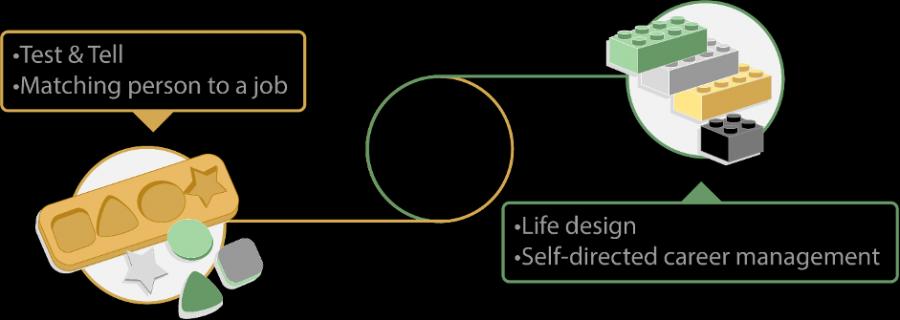
Modern approaches to career development

Narrative Counselling
- Recent decades have seen the emergence of narrative theories rooted in postmodern, constructivist and social constructionist approaches.
- These theories emphasise clients’ making meaning and taking action as they collaborate with career practitioners.
- Narrative counselling is crucial in supporting clients to adapt in a transitory, ever-changing world of work. Narrative approaches consider clients capable of telling stories that shape their identities by accentuating constructs of connectedness, meaning-making and agency

Career Construction Theory
- Individuals construct their careers by imposing meaning on their vocational behaviour and work experiences.
- In career construction, quantitative and qualitative techniques are integrated to help people make meaning in their careers.
- Objective and subjective approaches help to identify people’s traits, their ability to adapt and develop, as well as the reason they move in a certain direction.
- Career construction counselling can be described as lifelong, holistic, contextual and preventative.

Self-Construction Theory
- Self-construction theory asserts that individuals construct themselves in relation to specific dynamic contexts.
- Clients’ constantly unfolding identities are core to the theory of self-construction.
- The theory expands developmental theories, which maintain that identity construction unfolds continuously as clients progress linearly through fixed stages.
- Self-identity is constructed as clients narrate their stories. This self-identity evolves and changes as clients interact with facilitators or others during the counselling process.
Life Design Approach
- Life Design (LD) represents a new standard for career development in the 21st century.
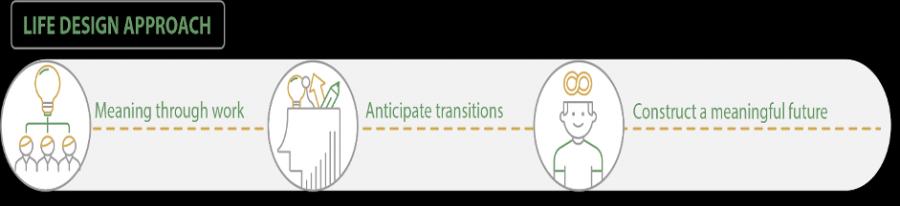
- LD expands 20th-century Person-Environment (P-E) fit and developmental models by focusing on making meaning through work.
- LD began from the work of an international group of over 25 scholars and practitioners in more than ten countries.
- LD highlights the need to encourage and support people in becoming experts in constructing their life-careers, to foresee and deal with transitions and to create hope for a meaningful future.
- Considers a person capable of shaping their own identity.
- Accentuates connectedness, meaning-making and agency.
- A person becomes an expert in designing their own career.
- A person empowered to manage their own career.
Shared under a Creative Commons Attribution-NonCommercial-ShareAlike 2.0 South Africa (CC BY-NC-SA 2.0 ZA)
This means you can share and adapt this work but not for commercial purposes. You will only need to include the following reference to the original content in all shared works.
Kindly attribute as follows:
Beukes, C. J., Mahadave, K., & Kanhai, K. (2022). Professional Development Portfolio for Career Development Practitioners (1st ed.). CC BY-NC-SA 2.0 ZA, https://creativecommons.org/licenses/by-nc-sa/2.0/za
Authors
 Karuna Mahadave
 Christopher John Beukes
You can earn 5.00 CPD point/s by completing and passing the self-assessment questionnaire for this article.
5.00